


 Download our Start-up Guide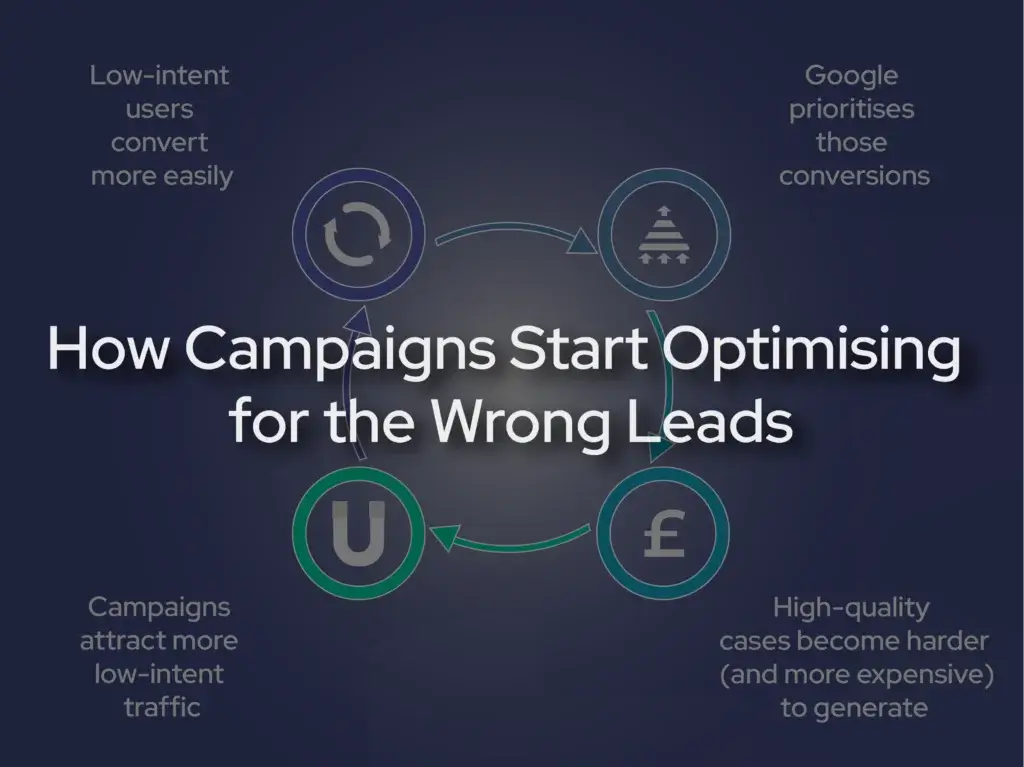
Why Personal Injury PPC Attracts the Most Expensive Junk Leads in Legal
Personal injury (PI) is one of the most competitive and expensive areas of legal marketing. It’s not uncommon for a single click to cost more than £10 and for a “lead” to cost £65 or more.
But here’s the real issue: not all leads are viable cases.
In fact, a significant portion of personal injury PPC enquiries are what many firms would consider junk leads and they are quietly driving up their costs.
The £65+ Lead That Was Never a Case
A typical scenario:
A potential client clicks your ad and calls your firm.
They explain:
- They slipped or tripped, e.g. in a supermarket… over three years ago;
- Liability is unclear;
- Or the claim value is minimal.
They’re not ready to instruct, and they’re exploring whether they’ve “got something”.
Google still counts this call as a conversion. Which also means you’ve just paid £65+ for a an enquiry you can’t take on.
Multiply that across a campaign and the cost of actual cases becomes significantly higher than your reported cost per lead.
Why This Happens in Personal Injury
Personal injury has a unique public perception. It’s often:
- Portrayed as a quick route to compensation,
- Highlighted in media with large payouts,
- Associated (rightly or wrongly) with claims culture.
As a result, many people search not because they have a strong case, but because they’re curious or trying their luck. They’re asking:
- “Do I have a claim?”
- “Is this worth anything?”
These are not clients, they are researchers. And they behave very differently from someone with a genuine, viable case.
The Main Problem: Google Can’t Tell the Difference
To Google Ads, these two users look identical:
- Someone with a clear, documented injury and strong claim,
- Someone testing whether a minor incident could lead to compensation.
They:
- Use exactly the same keywords,
- See and then click on the same ads,
- Call or submit forms in the same manner.
So Google treats them as equally valuable.
How Campaigns Start Optimising for the Wrong Leads
This is where things start to break in your campaign.
Once these low-quality calls are counted by as conversions, Google begins optimising for the cheapest conversions, not necessarily the best ones. This in turn creates a feedback loop:
- Low-intent users convert more easily,
- Google prioritises those conversions,
- Campaigns attract more low-intent traffic, and
- High-quality cases become harder (and more expensive) to generate.

Unfortunately, you end up with:
- More “leads”,
- Lower reported cost per lead, but
- Fewer actual cases.
When a Campaign “Stops Working”
At this point, many advertising agencies say it’s just competition and that PI clicks are expected to be more expensive.
And whilst competition is naturally a factor, more often the issue is that the campaign is optimising with the wrong data.
The campaign is not broken. It’s doing exactly what it’s been told to do.
Why CPL Isn’t the Right Metric in PI
Cost per lead (CPL) is often used as the benchmark, but in personal injury, it can be misleading. This is because:
- A 30-second call counts the same as a qualified enquiry,
- A “do I have a case?” call counts the same as a retained client.
The metric that actually matters is Cost per signed case and you cannot measure that properly without understanding lead quality.
The Fix: Optimise for Cases, Not Calls
To improve performance of your PI advertising campaign, you need to go deeper than surface-level metrics. One of the most effective ways to do this is through call-level qualification.
This means understanding:
- What was said on each call,
- Whether the enquiry was viable, and
- Which campaign and specific keyword generated it.
With the right tracking in place, you can:
- Identify which calls describe genuine cases,
- Spot keywords attracting low-intent traffic, and
- Separate “researchers” from real clients.
Changing the Way Campaigns Optimise
Once you have that data, everything changes. You can:
- Send only qualified leads back to Google as conversions,
- Exclude low-quality enquiries from optimisation signals,
- Focus spend on campaigns that produce real cases.
This allows the algorithm to learn what a real PI client looks like, not just what a searcher looks like.
The Agencies That Perform Best in PI
The agencies that succeed in personal injury PPC aren’t always the ones spending the most. They are the ones who filter out low-quality traffic, reduce wasted spend for their clients, and optimise based on case quality, rather than just lead volume.
In other words, they don’t just generate leads; they generate work for their law firm clients.
At Intellistart, we don’t believe in simply launching campaigns and “letting them run”. We look at the wider picture; from the structure of your campaign and landing pages to the quality of the enquiries actually coming through to your team.
A campaign that generates a high volume of calls but very few viable cases is not a successful campaign in our eyes.
Our focus is on helping law firms attract genuine instructions, not just curiosity traffic from people researching whether they may have a claim. Informational and research-based search intent is often better suited to long-term SEO and GEO strategies, while PPC should be focused on generating commercially viable enquiries.
That’s why we typically begin by reviewing:
- Your current campaign structure,
- Where your enquiries are being directed (your website or landing page),
- Your conversion and tracking setup,
- And whether the data being fed back into the platform reflects genuine case quality.
Where appropriate, we may recommend additional tracking measures, including call tracking solutions, to help improve visibility over which enquiries are valuable and which are unnecessarily increasing acquisition costs.
The law practices achieving the strongest long-term results from PI PPC are rarely the ones generating the most leads. More often, they are the firms generating the highest proportion of viable cases from their advertising spend.
Google Ads Isn’t Expensive Purely Because of Competition
The way the Google Ads platform works today is that, regardless of whether your budget is high or low, you will typically receive the level of market exposure your budget allows.
What makes it expensive, particularly in personal injury, is a mixture of the following:
- Low-intent traffic is common,
- Google cannot distinguish lead quality without detailed, granular data,
- Campaigns often end up optimising in the wrong direction.
Without proper qualification, you risk paying for:
- Curiosity (better targeted with SEO),
- Speculation,
- And enquiries that never become cases.
If your campaign is generating leads but not translating into actual work, it’s usually a sign that it’s worth looking more closely at what’s really coming through.
Request a No-Obligation Ad Campaign Review
If you’d like someone independent to look at your ad set up and scrutinise your account, we offer a no-obligation review of ad campaigns, including, keyword and targeting insights, tracking review, and practical recommendations to improve performance.
We don’t outsource or tie our clients into long-term contracts, and we have no set-up fees.
Get in touch with our team today to request a free review of your Google Ads account.
Contact us