


 Download our Start-up Guide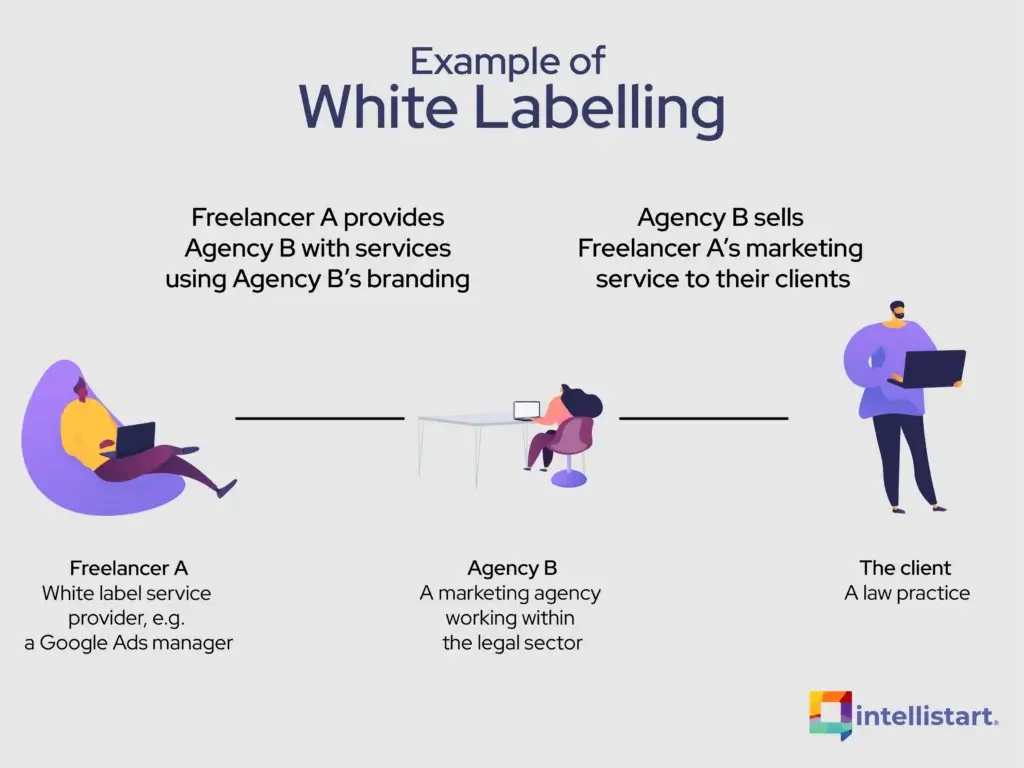
What Is White Labelling — And Why It Matters for Law Firms Choosing a Marketing Agency?
With hundreds, if not thousands, of marketing agencies targeting law firms across England and Wales, choosing the right partner can be difficult.
One concept that is rarely explained, but can have a significant impact on results, is white labelling.
Understanding how this model works, and its potential drawbacks, can help law firm owners like you make more informed decisions when selecting a marketing agency.
What Is White Labelling?
White labelling is a practice where an agency sells marketing services that are actually delivered by a third party, but presented under the agency’s own brand.
In practical terms, this means:
- Your website may be built by an external agency
- Your Google Ads campaigns may be managed by a freelancer
- Your SEO may be handled by someone based overseas with little or no understanding of the UK legal landscape
All while the agency you hired acts as the middle layer.
For law firms, this can mean that key parts of your marketing are being handled by individuals who:
- You have no direct access to
- May not specialise in the legal sector, and
- Are not fully accountable to you
Where Problems Start to Appear
1. Lack of Accountability
When services are outsourced, responsibility becomes blurred. If something goes wrong:
- The agency may blame the third party
- The third party may not communicate directly with you
- Issues can take longer to resolve
This can create frustration and slow down progress.
2. Limited Understanding of Your Firm
Agencies that rely heavily on white labelling often operate more as sales organisations than technical specialists. This can result in:
- Generic marketing strategies, not suitable for law firms
- Limited understanding of your practice areas
- Poor alignment with your firm’s commercial goals
Legal marketing is not one-size-fits-all. It requires an understanding of:
- Client behaviour
- Regulatory considerations
- How legal enquiries convert into actual cases
3. Quality Control Issues
A major risk with white labelling is the lack of direct quality control. In some cases:
- Websites are built using generic templates or outdated site builders, with very little to no optimisation
- SEO work follows outdated or ineffective practices that don’t account for the changes in search engine algorithms and user behaviours
- PPC campaigns are poorly structured and managed, leading to higher costs and weaker results
If the agency you’re dealing with doesn’t have the technical expertise in-house, they may not even realise when something isn’t performing properly and or/how to fix it.
4. Communication Breakdowns
One of the most common frustrations for law firms is not knowing who is actually doing the work. This can lead to:
- Delays in implementing changes and communication
- Miscommunication between parties
- A lack of clarity on strategy and performance
In fast-moving areas like PPC, this can directly impact results and cost.
5. Diluted Brand and Messaging
When multiple external parties are involved, consistency can suffer. This can lead to:
- Inconsistent tone of voice
- Generic website content
- Marketing that doesn’t reflect your firm’s positioning
For law firms, where trust and credibility are essential, this can be particularly damaging.
A Real-World Example
At Intellistart, we have worked with law firms who experienced the downside of this model first-hand.
In one case, a law firm had spent over £3,000 on Google Ads campaigns that were not generating results. They had been led to believe that the issue was their own, rather than the campaign itself.
When we reviewed the account, it became clear that:
- Their Google Ads campaign structure was inefficient
- Budget was being spent in the wrong areas and on the wrong keywords
- There was little meaningful optimisation
This is a common issue when there is no direct accountability or specialist oversight.
The Alternative: In-House Expertise
Not all agencies operate this way. Agencies with in-house teams:
- Deliver the work themselves
- Maintain full control over quality
- Provide direct access to the people managing your campaigns
This typically results in faster decision-making, better understanding of your firm, and more consistent performance. It also means the person you speak to understands the work in detail, not just at a high level.
Making an Informed Decision
Choosing a marketing agency is an important decision for any law firm. When evaluating your options, it is worth asking:
- Who will actually be doing the work?
- Will I have direct access to them?
- Is the work done in-house or outsourced?
- How is quality controlled?
Transparency in these areas can often be a strong indicator of how an agency operates.
Our Approach
At Intellistart, all work is carried out in-house.
We do not outsource. We do not use freelancers.
This means that you speak directly to the people doing the work and we maintain full control over quality and performance and build a deeper understanding of your firm over time.
It’s a simpler, more accountable way of working, and one that aligns with how most law firms operate internally.
White Labelling Isn’t Inherently Wrong, But…
White labelling is a model that law firms should understand before engaging an agency.
While it may allow marketing agencies to scale quickly, it can introduce challenges around quality, communication, and accountability for their clients.
For law firms looking to build a reliable and effective marketing system, working with an agency that offers transparency and genuine expertise can make a significant difference.
0161 877 4888 Contact our in-house experts