


 Download our Start-up Guide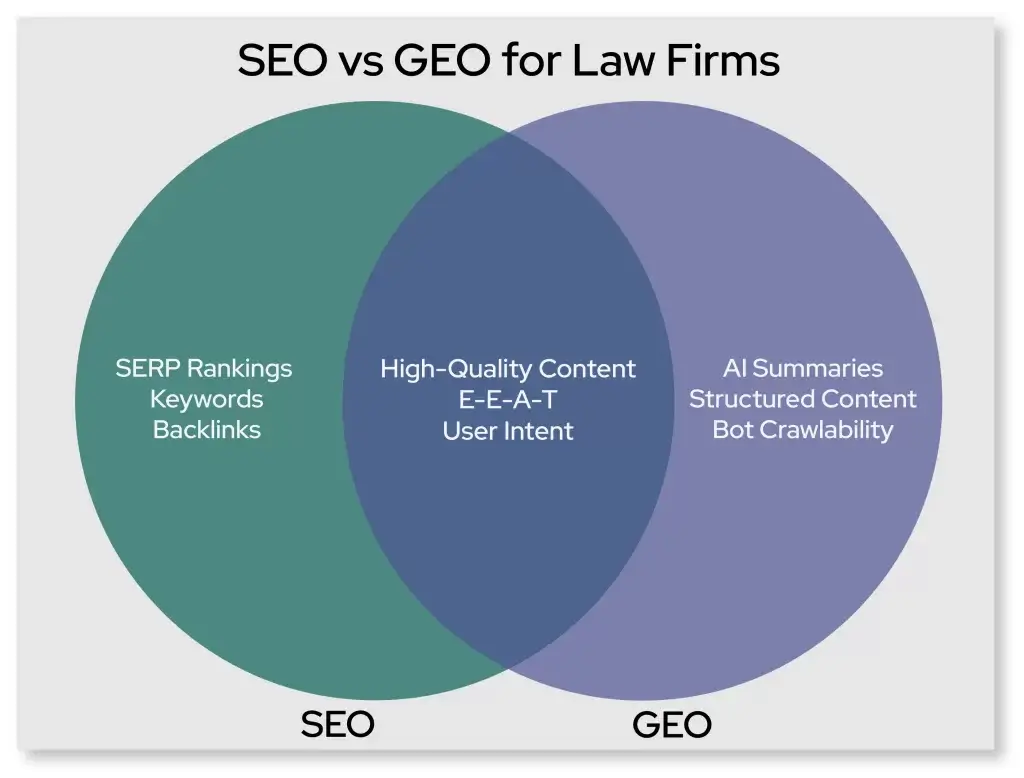
Generative Engine Optimisation for Law Firms: What We Know So Far
SEO is changing rapidly. With AI tools like ChatGPT, Google AI Search, and Perplexity becoming mainstream, we’re entering a new era of search – Generative Engine Optimisation (GEO).
GEO is the practice of optimising legal content for AI-driven engines, which work differently from traditional search engines but still rely on high-quality, crawlable content.
If your law firm’s website hasn’t been updated since 2017 (since the Fred update to Google search), now is the time to review it. If your site was built with Core Web Vitals, clear structure, and accessibility in mind, you’re in a much stronger position already.
The good news? GEO isn’t as intimidating as it sounds. In many ways, it builds on tried-and-tested SEO principles.
What is Generative Engine Optimisation (GEO)?
GEO is about maximising your law firm’s visibility in AI models. Unlike SEO, which focuses on ranking in search engine results pages (SERPs), GEO ensures your site can be read and surfaced by AI crawlers that feed LLMs (large language models).
Generative engines don’t just show links. They provide summaries, drawing from web content and other sources.
Examples include:
- ChatGPT
- Perplexity AI
- Google AI Search
How Do Generative Engines Work?
- Interpret a user’s query (sometimes with context from previous searches or preferences).
- Crawl web content and sources to find relevant material.
- Transform the findings into a natural language response.
GEO vs SEO for Law Firms
Similarities
- Both help users access useful information. Whether a potential client uses Google, Bing, or ChatGPT, the goal is the same: quick, accurate answers.
- High-quality content matters. Blogs, service pages, and guides that provide valuable insight perform well in both SEO and GEO.
- E-E-A-T remains key. Expertise, Experience, Authoritativeness, and Trustworthiness are still important signals for visibility.
- Keywords still count. People still search using phrases, even if queries are more conversational in AI engines.
Differences
- Focus: SEO is about SERP rankings. GEO is about being crawlable and usable by AI bots.
- Structure: GEO rewards short sentences, bullet points, and clear formatting. That’s how AI engines easily extract snippets.
- Output: SEO produces a ranked list of sources. GEO outputs a summary that may cite or paraphrase content.
What This Means for Law Firms

Ewelina Radziewicz
Intellistart COO
SEO & Web Design Expert
- Readability matters. AI tools pull short, structured content. If your site is cluttered or difficult to crawl, you’re at a disadvantage.
- Conversions may be higher. “We’ve seen signs that conversions from LLMs are stronger,” Ewelina explains. “People trust AI as if it’s done the research for them. That level of trust means they’re more likely to convert without browsing dozens of sites.”
- But quantity is still low. “We’re only at the beginning,” she warns. “Traffic volumes from AI are still relatively small, so law firms shouldn’t throw out SEO altogether.”
Do Law Firms Need to Worry?
Not necessarily, but they do need to adapt.
- Local SEO is still strong. For searches like “family lawyer in Manchester”, Google Maps, reviews, and local results remain dominant.
- Clicks may drop on blogs. Informational content could see fewer clicks, as AI engines summarise quickly. But users still click through for detail or reassurance, so content is still valuable.
- Bottom-funnel clicks matter most. For law firms, leads come from clients looking for services, not just information. Strong, optimised service pages are vital.
Practical Steps for Law Firms
- Review whether your hosting or CMS is blocking AI crawlers.
- Make sure your website is fast, secure, and easy to navigate.
- Structure content with headings, short sentences/paragraphs, and bullet points. Q&A sections are also good.
- Keep creating informative blogs, but prioritise service pages that drive client enquiries.
Final Thoughts
Generative engine optimisation is not replacing SEO, it’s an extension of it.
At Intellistart, many of our clients are already benefitting from visibility in AI search engines without major changes. That’s because their websites were built with structure, readability, and best practices in mind from the start.
GEO is still evolving, but law firms that prepare now, by ensuring their websites are crawlable, client-friendly, and content-rich, will stay ahead of competitors.
GEO vs SEO for Law Firms: Key Differences Summary
| Feature | SEO (Search Engine Optimisation) | GEO (Generative Engine Optimisation) |
|---|---|---|
| Primary Goal | Rank in Google/Bing search results (SERPs) | Be visible in AI-generated answers (ChatGPT, Perplexity, Google AI) |
| Output | Ranked list of links | AI summary or direct answer (may cite sources) |
| Content Style | Long-form, keyword-rich, optimised for SERPs | Short, structured, easy-to-extract snippets |
| User Journey | Click-through to website from results | Information consumed within AI tool, with optional click-through |
| Importance of Structure | Helpful, but less critical | Crucial: headings, bullet points, short sentences |
| Traffic Source | High volume (Google still dominant) | Emerging, lower traffic but growing |
| Conversion Impact | Varies—CTR depends on rankings and competition | Early signs of higher conversion rates due to user trust in AI responses |
| Longevity | Established, still essential | Emerging, but rapidly gaining importance |
FAQs for GEO for law firms
SEO focuses on ranking in search engines like Google, while GEO ensures your law firm’s site is visible in AI search engines like ChatGPT or Perplexity.
No. GEO builds on SEO. Traditional search is still dominant, but GEO is growing. The two work hand-in-hand.
Check if your site is accessible to AI crawlers, loads quickly, and has well-structured content with headings and bullet points.
It’s early days, but there are signs GEO visibility leads to higher conversion rates, as users tend to trust AI recommendations.
Yes, but not at the expense of SEO. Building structured, high-quality content benefits both. Think of GEO as future-proofing your online presence.
