


 Download our Start-up Guide
Ewelina Radziewicz
/ɛ.vɛˈli.na radˈʑɛvʲitʂ/
Chief Operating Officer | Head of SEO & Website Design at Intellistart Law Firm Marketing
About Ewelina
“I am a digital strategist and website specialist working at the intersection of SEO, web design, and technical systems for law firms and professional services businesses.
I currently serve as Head of SEO & Web Design at Intellistart while also founding a tech procurement business that works alongside our agency to support our clients with more integrated digital and operational solutions.
This dual role allows me to bridge both strategy and implementation, ensuring that websites are not only well-designed, but commercially effective and technically scalable.”

Ewelina has been nominated for the 2026 Novi Young Entrepreneur of the Year Award

A title
Image Box text
Ewelina’s Core Focus
My core focus is building WordPress websites and landing pages that are engineered for performance, combining SEO, GEO, and AI-driven search optimisation to turn websites into consistent sources of qualified legal enquiries.
Rather than treating design and SEO as separate disciplines, I approach them as one system:
structure, content, and technical foundations working together to improve visibility and conversion.
My work at Intellistart
On the delivery side, I typically design between 6 and 12 bespoke law firm websites per year, alongside ongoing SEO, landing page campaigns for PPC clients, and consulting and strategy work.
Across our work, we have supported over 200 law firms in England and Wales, ranging from boutique practices to multi-partner firms generating seven-figure revenues, through audits, strategy, implementation, and optimisation.
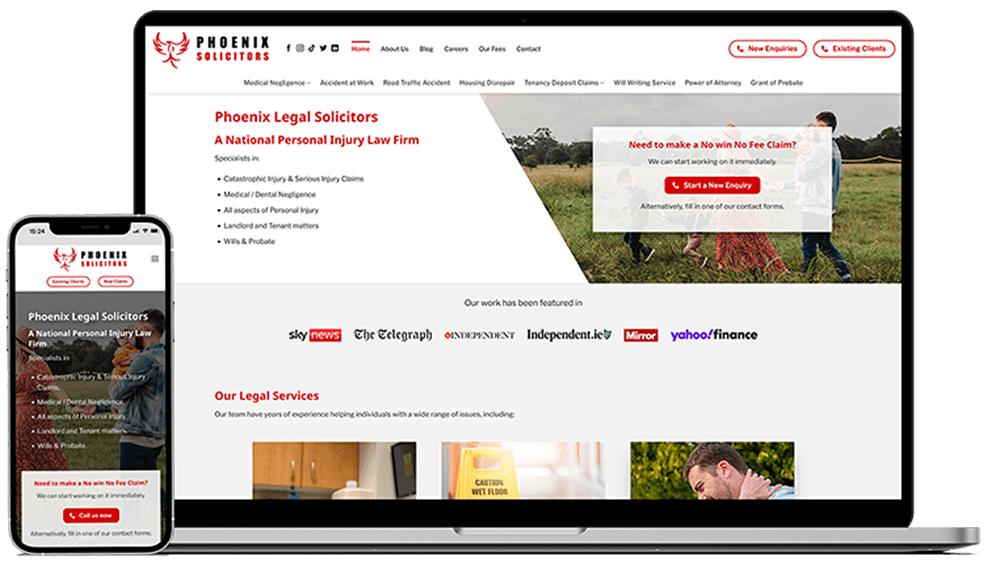
You may have already come across some of my designs, for instance, the Phoenix Legal Solicitors website.
Visit Phoenix Legal Solicitors' website
Legal Sector Contributions
I have contributed to the legal sector through articles published with The Law Society of England and Wales, focusing on SEO, digital visibility, and the role of strategically designed websites in modern law firms.
Alongside this, I regularly publish content on legal marketing and digital strategy, with a focus on practical, applied insights rather than generic industry commentary.
Results achieved for our clients
Our SEO clients typically see results in multiple stages: technical improvements and visibility gains can be immediate where foundations already exist, while growth typically compounds over a 3 to 6-month period and beyond as authority and indexing develop.
For SEO with website design results can be immediate with firms gaining rankings within weeks of websites going live.
Our clients also benefit from SEO optimisations making their advertising campaigns significantly cheaper.
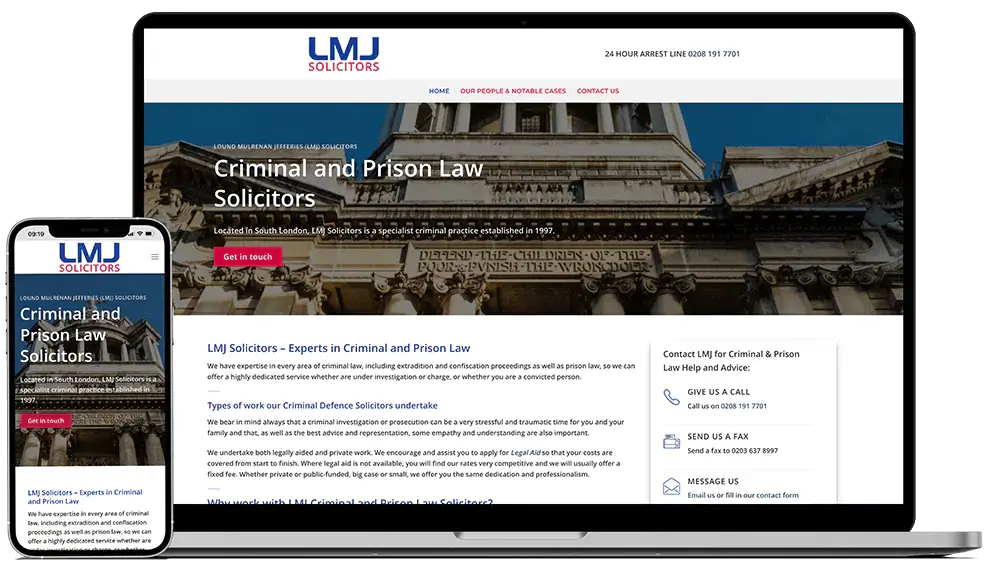
Read specific client case studies to find out more:
Blogs written by Ewelina

Make Intellistart Your Preferred Source on Google | Legal Marketing
There is no shortage of information online. Search for almost anything relating to legal marketing, [...]
Aug

What Makes a Successful Google Ads Campaign for a Law Firm?
The first impression rarely comes from your advert. It comes from the page your advert [...]
Jul

Intellistart Law Firm Marketing Shortlisted for Business of the Year 2026 Award
We’re delighted to share that Intellistart Law Firm Marketing has been shortlisted as a finalist [...]
Jul

PPC Advertising for Law Firms: Why Most Google Ads Campaigns Underperform?
A law practice may spend thousands of pounds every month on Google Ads while having [...]
Jul

AI Search Optimisation Agency for Law Firms & Solicitors
AI Search Optimisation Agency for Law Firms & Solicitors (UK & London) The legal industry [...]
Jun

GEO for Law Firms | Google’s AI Search Guidance Explained
As AI-powered search continues to evolve, many law firms are hearing new marketing terms such [...]
Jun

Are Your Contact Forms Storing Client Data? Law Firm Website Risks Part 2
Are Your Contact Forms Storing Client Data? Many law firms understandably focus on the visible [...]
May

Plugins, APIs & AI Tools: The Website Risks Law Firms Should Understand
WordPress itself is not inherently dangerous or insecure. In fact, it powers a significant percentage [...]
May

Academic background
My academic background in Linguistics (BA Hons) plays a central role in my approach to design and SEO.
I view search engines and AI systems as language-based models that interpret meaning through structure, semantics, and context. This is why I place particular importance on schema markup, structured content, and information architecture, ensuring that law firm websites are not only visually strong, but also accurately understood, interpreted, and surfaced by both Google and AI-powered systems.

Skills our clients benefit from
Before moving into digital, I worked across finance and insurance, managing risk and supporting commercial processes tied to high-value clients, including preparing client-facing quotations designed to generate business at scale.
This experience shaped my understanding of commercial risk, client expectations, and the importance of measurable value, principles I now apply directly to digital performance and marketing strategy.
By combining linguistics, SEO, website design, structured data, and AI search optimisation, I build digital assets that help firms attract qualified enquiries and remain discoverable in an increasingly AI-driven world.
Additionally, as a business owner myself, I understand that marketing isn’t an academic exercise. Every investment needs to justify itself commercially.
Why law firm marketing?
Law firms operate in one of the most competitive and highly regulated sectors online. Success requires more than generic marketing advice; it requires an understanding of how potential clients search, evaluate trust, and choose legal representation, as well as regulatory compliance considerations.
Over the years, I have worked with more than 200 law firms across England and Wales, helping them improve their websites, search visibility, and enquiry generation. My background combines SEO, website design, linguistics, technical implementation, and commercial strategy, allowing me to take a broader view of what drives sustainable growth for legal practices.
Rather than focusing solely on rankings, I focus on building digital assets that help firms attract, convert, and retain the right clients.

Read our client testimonials
What clients consistently value most is not just the output, but Ewelina’s ongoing approach.
Feedback highlights her responsiveness, attention to detail, and a proactive focus on continuous improvement, whether in website builds, SEO performance, or ongoing optimisation.
– Stuart Matthews, Treadstone Law Solicitors in Manchester
Your questions answered
Many legal marketing consultants come from legal backgrounds, having previously practised law or worked within the legal sector. Whilst this provides valuable industry insight, my background is different.
My expertise lies in understanding how law firms are discovered online and how modern search technologies interpret information. I specialise in the areas that directly influence digital visibility, including website design, SEO, structured data, user experience, conversion optimisation, and AI-powered search.
My academic background in Linguistics has also given me a unique perspective on how search engines and AI systems process language, context, and meaning. This influences how I structure websites, content, and technical SEO, helping ensure that both Google and AI tools can accurately understand and surface a firm’s expertise.
Alongside this, I have experience in finance, insurance, and business development, as well as running my own businesses. This means I approach marketing from a commercial perspective, focusing on return on investment rather than vanity metrics, such as keyword impressions.
Having supported more than 200 law firms across England and Wales, my goal remains simple: to help firms build websites and marketing systems that generate qualified enquiries and support long-term growth.
Search is changing rapidly. Potential clients are no longer finding law firms exclusively through traditional Google searches. Increasingly, they are using AI-powered platforms and answer engines to research legal services and compare providers.
My background in SEO, web design, linguistics, and structured data allows me to help law firms prepare for both traditional search engines and emerging AI technologies. By ensuring websites are technically sound, well-structured, and machine-readable, I help firms improve their visibility across both channels.
This approach combines proven SEO principles with a forward-looking understanding of how AI systems discover, interpret, and reference online information.
Additionally, as I optimise websites at the same time as building them, it provides a better long-term investment for our clients who do not need to seek an SEO to optimise their site once it has been published. Your website can instead start working for you immediately.
I believe that SEO should be viewed as a long-term investment rather than a quick fix.
In many cases, law firms begin seeing improvements within the first three months, particularly where technical issues are resolved or existing content is quickly optimised.
However, meaningful growth typically builds over time as search engines gain confidence in a website’s authority and relevance. The exact timeframe depends on factors such as competition, website history, the firm’s existing online presence, and other marketing strategies employed.
Depends.
Many websites can achieve significant improvements through technical optimisation, content enhancements, and better site structure. However, if a website has fundamental usability, performance, or technical limitations, a redesign may provide a stronger foundation for future growth.
Every firm is different, which is why we typically begin with a complimentary audit before recommending any major changes.
Yes. Unlike many consultants who focus solely on strategy, I am actively involved in the design and development process.
This allows me to ensure that SEO, technical performance, user experience, and conversion considerations are incorporated from the beginning rather than added as an afterthought.
Over the years, I have worked with firms specialising in civil, corporate and commercial and criminal law.
Many law firms treat their website as an online brochure rather than a business development asset and the foundation of their wider marketing strategy.
A successful website should not only communicate expertise but also make it easy for prospective clients to find information, build trust, and take action. Poor structure, slow performance, unclear messaging, and weak calls-to-action can all result in missed opportunities.
Your website should act as the central hub for your marketing activity. Whether enquiries originate from search engines, social media, paid advertising, PR campaigns, referrals, or AI-powered search tools, prospective clients will often visit your website to verify your credibility and decide whether to get in touch.
Unlike social media platforms, which are owned by third parties, your website is a digital asset that you control. It allows you to collect valuable first-party data about how visitors find you, which services they are interested in, and how they engage with your content. These insights can then be used to make more informed marketing decisions and improve future performance.
Think of your website as your firm’s digital headquarters. If a social media campaign performs exceptionally well but directs visitors to a poorly designed or poorly structured page, conversion opportunities can be lost. The stronger the website foundation, the more effective every other marketing channel becomes.